Textiles & Everyday Comfort
Wool Throws: How Fiber, Weave, and Weight Shape Everyday Comfort
A wool throw can be a modest domestic instrument: warmth at the shoulders, a soft boundary between an evening and the night, a little insurance against a room that insists on being cooler than its occupants. Yet “wool” is only the beginning of its story. Fiber, weave, weight, and finishing determine whether a throw feels airy or substantial, smooth or nubby, neatly behaved or inclined to slip from the sofa at the first sign of movement.
Published November 6, 2026
The useful mystery of wool
People tend to describe wool by its most dramatic quality: warmth. This is reasonable. On a cold afternoon, the ability of a throw to make a lap feel like a more habitable place is not an abstract matter. But wool’s usefulness is less like a switch and more like a small climate system. It can hold insulating air, respond to moisture, and provide a layer that feels comfortable across a range of conditions. How successfully it does so depends on the particular fiber and the textile made from it.
Wool is not a single, uniform material. It may come from different breeds of sheep, and the character of the fiber varies with factors including fineness, length, and crimp—the waviness along the fiber. Other animal fibers, such as alpaca or cashmere, are also commonly discussed alongside wool, though each has its own properties and care considerations. Even within a product described simply as “100% wool,” the hand and performance can differ considerably.
There is also a distinction between what a fiber can do and what a finished throw actually does. A fine, lofty wool yarn woven loosely may produce a light, airy blanket. A thicker yarn packed into a dense fabric may create a heavier, more enveloping layer. Fiber content matters, but it is not a complete buying guide. The cloth, after all, is made from more than its ingredients: it has structure, thickness, and a finish.
Fiber: softness, warmth, and the question of touch
The first encounter with a throw is usually tactile. A hand moves across the surface; a corner is lifted; perhaps the fabric is pressed to the cheek, a test conducted with the seriousness of a person evaluating a new pillow. The experience depends partly on fiber fineness. Coarser fibers can feel more textured or prickly against sensitive skin, while finer fibers often feel smoother. But the yarn’s twist, the fabric’s construction, and any surface finishing also influence the result.
“Soft” is therefore not a technical guarantee. One person’s pleasantly nubby blanket may be another person’s reason to reach for a cotton layer. If the throw will rest directly against bare arms or be used by someone sensitive to texture, try to assess the actual fabric rather than relying on a generic description. When shopping online, look for specific material details, care instructions, and a clear return policy. If possible, handle a similar fabric in person. A photograph can communicate color and pattern; it is less persuasive about the sensation of a fiber at the wrist.
Wool’s ability to insulate is commonly linked to the air held within and around its fibers and yarns. The result is not simply a question of putting more material between a person and the room. A relatively light textile can feel warm if its structure traps air effectively; a dense one can feel weightier without necessarily being more comfortable in every setting. The desired balance changes with climate and use. A throw for a chilly reading chair may welcome a little heft. For a warm apartment or an afternoon nap, a lighter fabric may be easier to keep in place.
Fiber can affect maintenance, too. Wool fibers have a natural structure that may resist some everyday soil and odor, but this does not make a wool throw immune to stains or wear. Nor does it mean every wool textile can be washed in the same way. The label is more useful than a broad claim about what wool “usually” tolerates. Processing, yarn, dyes, and construction all matter.
Weave: the architecture beneath the surface
Weave is the arrangement of yarns that turns separate threads into a stable cloth. In a woven textile, lengthwise warp yarns cross with widthwise weft yarns. The pattern of those crossings affects the surface, flexibility, durability, and drape. A plain weave, with a regular over-and-under structure, can produce a straightforward, balanced fabric. Twill uses a staggered pattern that creates a diagonal line and often gives the cloth a supple hand. More elaborate woven structures may introduce longer floats, raised textures, or decorative motifs.
Those terms describe construction, not a ranking of quality. A simple weave can be beautifully made; a complex surface is not automatically more durable. The practical question is what the structure contributes to the way the throw will be used. A compact fabric may hold its shape and tolerate regular handling well. A loose or open weave can feel lighter and allow air to move through it, though it may be more vulnerable to snagging. A raised or brushed surface can feel inviting and visually rich, while requiring a little more care around friction and pilling.
Not every throw is woven. Knitted fabrics are formed from interlocking loops, which generally allow more stretch than many woven structures. A knitted throw can have a softer, more elastic drape; the degree of stretch and resilience depends on its stitch pattern and yarn. “Knit” and “woven” are not synonyms for casual and formal, or soft and stiff. They are different ways of building fabric, each with many possible results.
Pattern can offer clues, but it cannot settle the matter. Plaid, for instance, may be woven from yarns of different colors, printed onto a finished cloth, or produced through other methods. A pattern name alone does not tell you whether a textile is dense, loosely structured, or brushed. If construction details are absent, it is sensible to treat the appearance as a design feature rather than evidence of a particular performance.
Edges deserve a glance as well. A finished hem, fringe, or bound edge can influence how a throw wears and how its outline reads in a room. Fringes may be part of the textile structure or added as a finish; in either case, repeated pulling or snagging can loosen them. Seams and edge finishing do not make a throw warm by themselves, but they help determine whether it keeps its shape after years of being lifted, folded, and casually entrusted to a sofa.
Weight and drape: the comfort of being covered
Fabric weight is often discussed as though it were a direct measure of warmth. It is an important clue, but not a verdict. Weight may be stated in grams per square metre, ounces per square yard, or simply as a qualitative description such as “lightweight” or “heavy.” Product listings do not always give a standardized figure, and a number cannot account for every aspect of construction. Thickness, density, weave, and the volume of trapped air all contribute to how warm a throw feels.
There is a more immediate way to understand weight: notice what happens when the cloth is lifted and allowed to fall. Does it settle in a broad, steady fold, or float in a loose, shallow cascade? This is drape—the way a textile hangs under its own weight. A substantial throw may make a satisfying, sheltering layer over the legs. A lighter one may be easier to gather around the shoulders or carry from room to room. Neither quality is universally preferable. The best choice is the one that suits the human habits of the household, including the habit of leaving the blanket in a heap until morning.
Consider the setting. In a cold room with hard floors and a persistent draft, a heavier throw may serve as an extra layer over clothing or bedding. In a well-heated room, the same weight could feel excessive. For a shared sofa, a medium-weight blanket is often a practical compromise: substantial enough to be useful, but not so bulky that folding it becomes a small architectural project. For travel or a reading chair, portability may matter more than maximum warmth.
Size changes the experience. A throw intended to cover one person’s lap has different requirements from one expected to reach across a sofa or wrap around two people. Compare stated dimensions with the way the blanket will actually be used. A generous size can be lovely, but additional area also means additional weight and more fabric to wash and dry. The familiar word “throw” does not, by itself, promise a particular dimension.
A practical way to choose
A useful throw buying guide begins not with a trend or a color but with a scene. Picture the room, the season, and the person using it. A blanket that will live beside a fireplace has different obligations from one that spends most of its time folded at the end of a bed. Ask what the textile must do before asking what it ought to look like.
- Start with use. Decide whether the throw is for occasional decoration, daily lounging, an extra bed layer, or a combination of these. Frequent use calls for attention to durability, cleaning, and the likelihood of snagging.
- Read the fiber label. Look for the stated composition, not just the word “wool” in a product name. Blends may alter softness, price, resilience, and care requirements. Ask for clarification when the material description is vague.
- Look for construction details. Weave, knit structure, brushed or raised finishes, and edge treatment can help explain how a throw may feel and behave. If those details are not provided, avoid assuming them from the pattern or marketing language.
- Match weight to climate. Think about room temperature and whether the throw will be used over clothing, on bare skin, or as a layer over bedding. A heavy textile is not automatically the most comfortable choice.
- Check dimensions. Measure the intended chair, sofa, or bed. Compare the listed size with how much coverage you want, remembering that a blanket can feel smaller once it is folded around a person.
- Consider care before purchase. A beautiful throw that requires a cleaning routine you cannot realistically follow may not be the right everyday textile. Check the manufacturer’s instructions and any cleaning costs before deciding.
Color and pattern enter the discussion, naturally. A quiet neutral may adapt easily to changing rooms; a plaid can give a sofa a little structure without requiring a redecorating campaign. These are matters of taste, but they have practical consequences: a blanket used every day will be seen every day. Choose something you expect to enjoy in ordinary light, not only in the idealized lighting of a catalog.
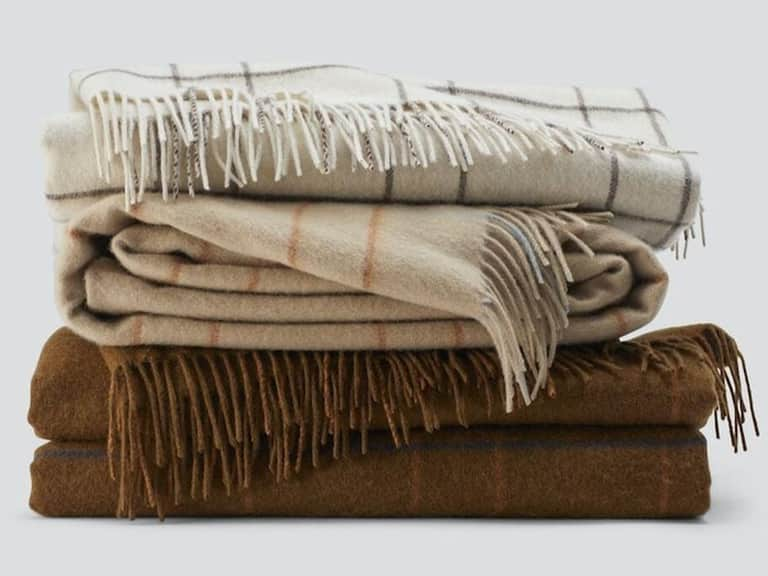
For a concrete example, the Pinstripe Plaid Throw is described as 100% wool, with a sweater-soft feel and intended for everyday comfort on a sofa or chair. That information establishes its fiber content and general use, but does not specify a weave or numerical fabric weight. Those are details worth checking if they are central to your decision. A good description should help a buyer understand what is known—and leave room for questions where the specifications are not given.
Care: gentle handling, fewer surprises
Wool care is sometimes made to sound like a secret rite involving moonlight and a specialized basin. In practice, it begins with a less romantic document: the care label. Follow the instructions supplied for the individual throw. Some wool textiles may be labeled for professional cleaning; others may permit hand washing or a carefully selected machine cycle. It is unwise to generalize from one wool sweater to every wool blanket, because fiber processing, dyes, and construction differ.
When washing is permitted, avoid treating the fabric as though it were a cotton towel. Agitation, abrupt changes in temperature, and unsuitable detergents can contribute to felting or shrinkage in some wool textiles. If hand washing is recommended, use cool or lukewarm water and a detergent intended for wool, and handle the throw with care. Rather than wringing or twisting it, press water out gently. For machine washing, use only a cycle and settings allowed by the care instructions. When the label calls for professional cleaning, that instruction is the prudent route.
Drying deserves equal attention. Heat and vigorous tumbling can alter size or texture, so do not assume a wool throw belongs in a hot dryer. If it is safe to dry flat, support the fabric evenly and reshape it while damp. Hanging a heavy, wet textile may stretch it under its own weight. Keep it away from direct heat unless the manufacturer’s instructions say otherwise, and make sure it is fully dry before folding it for storage.
Between washes, airing a throw can often be a sensible first step. If a small spill occurs, blot rather than rub; rubbing can work the stain deeper or roughen the surface. Address the spot according to the care label, and test any cleaning method discreetly where possible. Pilling—the formation of small fiber balls from friction—can occur on many textiles, including wool. It is not always evidence of poor quality, though excessive pilling may be frustrating. If removing pills, use an appropriate tool gently and avoid cutting or pulling at the fabric.
Storage and the long interval between cold evenings
At the end of the season, clean the throw as instructed and allow it to dry completely. Store it in a cool, dry place, away from direct sunlight, which can fade colors over time. A breathable cotton bag or clean shelf is generally a more sensible home than an airtight plastic container for a textile being stored for an extended period. Avoid compressing it under heavy objects; repeated pressure can flatten a lofty surface or crease the fabric.
Wool garments and blankets can be vulnerable to clothes moths and other textile pests, particularly when stored with food residue, body oils, or other organic matter. Clean storage, periodic inspection, and keeping the area tidy are straightforward precautions. Cedar or herbal sachets may be used by some households, but they should not be treated as a substitute for cleanliness and inspection. If a problem appears, consult reliable pest-control guidance rather than relying on a scented object to perform a task it may not be equipped to perform.
Fold the throw along different lines from time to time if it will remain stored for months. The practice is less about ceremony than preventing a single crease from becoming the textile’s permanent memory. When the weather turns again, open it, give it a little air, and check the edges before returning it to service.
Comfort is a construction, not a label
We often ask a throw to do several jobs at once: soften a room, warm a person, hold its color, survive a snack, and look composed while being used. No single fiber or weave can guarantee all of that. A successful choice comes from matching material and structure to the life the blanket is likely to lead. Wool may offer a useful balance of warmth, texture, and durability, but the details matter: the nature of the fiber, the density and openness of the fabric, the way it drapes, and the care it requires.
There is a particular pleasure in understanding those details without turning an ordinary purchase into an examination. A hand can still judge softness; a shoulder can still decide whether the weight feels right. Technical information simply gives those impressions a little context. When the room cools and someone reaches for the nearest blanket, the best throw is not necessarily the grandest or the heaviest. It is the one that feels right in use—and is well made and well cared for enough to be reached for again.
Quick reference
- Fiber influences softness, insulation, and care, but “wool” alone does not describe the whole textile.
- Weave or knit structure affects texture, airflow, flexibility, and how the fabric holds up to handling.
- Weight helps indicate how substantial a throw may feel; it is not a complete measure of warmth.
- Drape describes how a throw hangs and settles, an important part of comfort and everyday handling.
- Care instructions vary by product. Follow the label for washing, drying, and storage rather than relying on a universal rule.